


History
CompanyHistory1830 – 1906

From textile to paper printing

“Deutsche Photogravur” and Siegwerk

On February 24, 1906 two men who, just a few months before, had laid years of quarreling to rest, met in Cologne’s Dom Hotel. The reason for their dispute: both had developed a photochemical method of engraving gravure rollers. One, Ernst Rolffs, had acquired a patent contested by the other, Dr. Eduard Mertens. After a long, fruitless battle over intellectual property rights, Rolffs and Mertens decided to exploit the invention jointly. For this reason, they met in Cologne to found a company together: the “Deutsche Photogravur AG”.

Putting their signatures on the contract, Rolffs and Mertens wrote printing history. With its seat in Siegburg near Cologne, Deutsche Photogravur AG was not only one of the first gravure businesses in Germany, but also significantly contributed to gravure developing into an industrially exploitable printing method. The company marketed prints in large quantities and new quality dimensions. Additionally, cooperation with other firms yielded techniques and inks that fundamentally improved the gravure method.

One of Photogravur’s most important cooperation partners was the neighbouring “Kattunfabrik Siegfeld mbH” (formerly Rolffs & Cie.), which Ernst Rolffs’ grandfather had founded in 1830. Here, Rolffs’ had developed the first photo-chemically engraved gravure rollers for textile printing in the 1890’s, before applying his technology to paper printing. Kattunfabrik’s ink laboratory, which in 1911 gave rise to the “Siegwerk Chemisches Laboratorium GmbH” delivered the inks Ernst Rolffs needed for his printing machines.

The cooperation between Photogravur and Laboratorium led to the special combination of chemical competence and printing know-how that characterises Siegwerk to this day. Kattunfabrik was where the men who founded the company gathered experience and performed experiments. Their basic knowledge of printing inks and technologies was acquired in the production of printed cotton textiles.

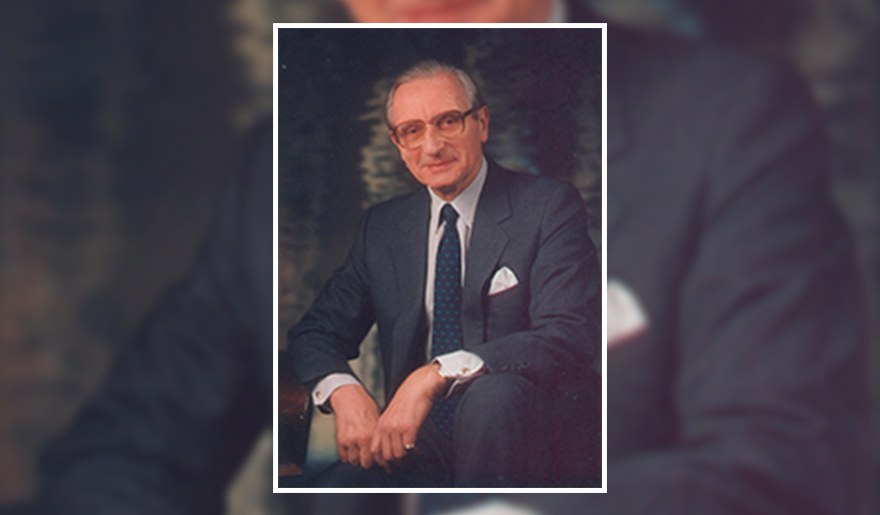
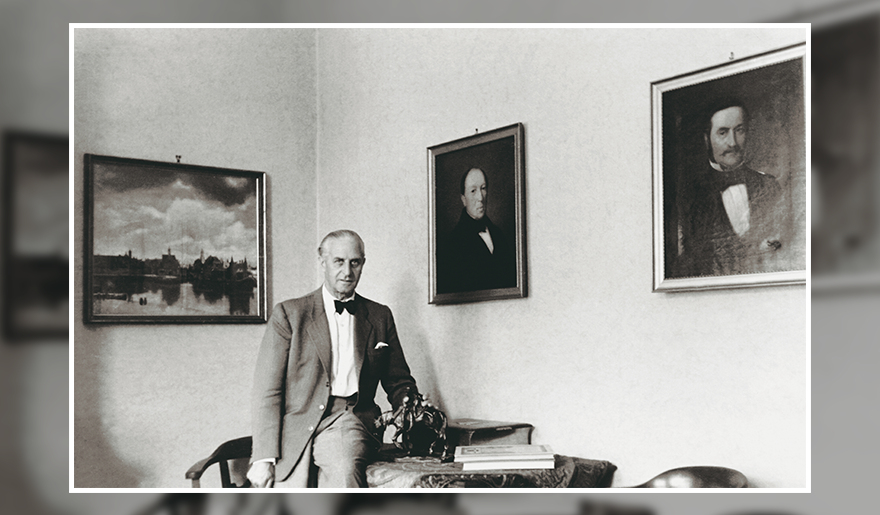
Ernst Rolffs junior – third generation inventor

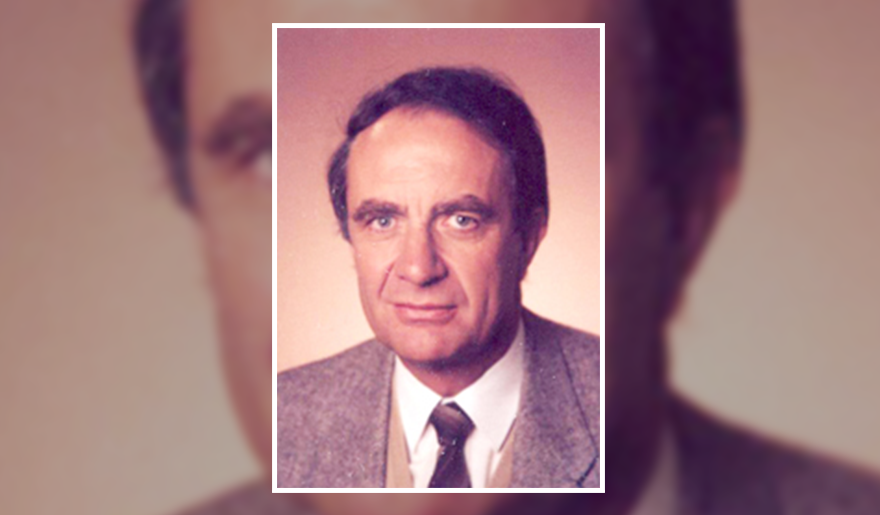
Ernst Rolffs – The founder of Deutsche Photogravur AG developed one of the first gravure methods for paper printing.
Born on March 22, 1859, Ernst Rolffs studied chemistry at the universities of Bonn and Strasbourg and then trained with Klimsch & Co. in Frankfurt /Main, where he further developed his knowledge of process engineering. In 1891, he became a partner in the Kattunfabrik Rolffs & Cie., which his grandfather Christian Gottlieb Rolffs had founded. Ernst Rolffs was not only a businessman, but a passionate inventor. A camera he acquired in 1895 first gave him the idea of using photochemistry for gravure printing on textiles. In 1902, he left Kattunfabrik to concentrate on his research full time. He developed several new printing processes and was one of the first to apply the gravure process, well proven in textile printing, to paper printing.

On February 24, 1906, he and Dr. Eduard Mertens (who had also developed a gravure process for paper) founded the Deutsche Photogravur AG. With reproductions of famous paintings, the company met the tastes of the period and reached a mass audience via the new illustrated magazines. Very soon, Deutsche Photogravur had a high reputation and trained a whole generation of gravure printers. High-quality books such as one printed for the 100th anniversary of the Krupp company or an art-historical book presented at the 1910 World Expo in Brussels were the company’s speciality. After World War I, the company was unable to resume the successful business of earlier years. Ernst Rolffs retired to Marienrachdorf in the Westerwald forest. He died during a stay in Heidelberg on January 9, 1939, and was buried in Siegburg.

In the beginning there was the Kattunfabrik

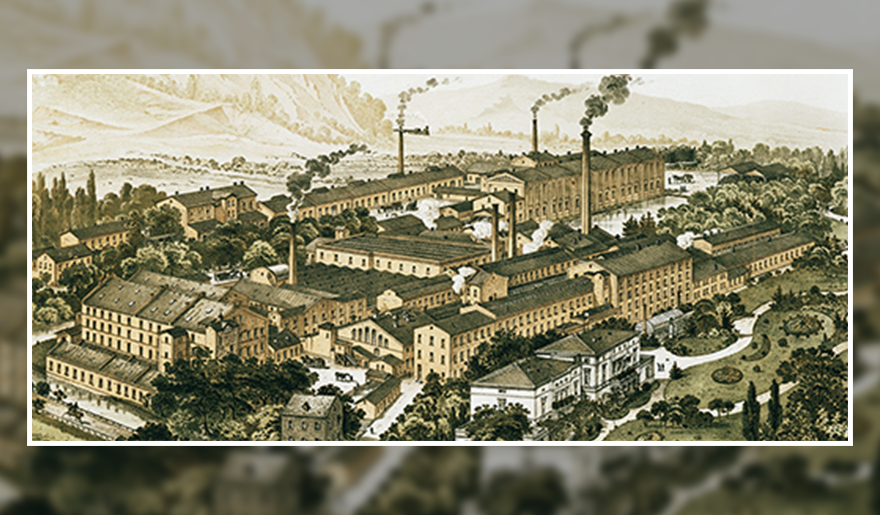
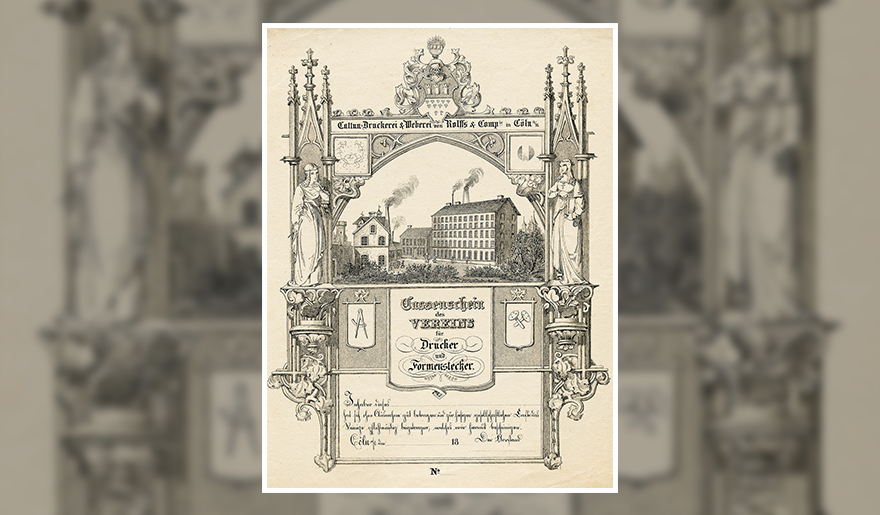
This "cash slip" shows Christian Gottlieb Rolffs' Cologne factory in 1840, where 410 employees were imprinting cotton with indigo blue.

The roots of the “Kattunfabrik” (calico factory) go back to the 1820’s. In those days, Christian Gottlieb Rolffs was a wholesaler in Cologne – initially in cooperation with his brother-in-law Carl Poensgen and from April 1, 1830, with his own “Manufakturwarenhandlung”. Rolffs was especially interested in the textile industry, keeping an attentive eye on its development in the Rhein region and neighbouring areas. Early on, he realised that the way blue-dyed or printed linens were produced in Germany was dated and could no longer satisfy demand. While the much-sought blue materials were being produced in large quantities by manufacturing firms in Belgium, German production was still mostly run by small and locally oriented craft establishments.

Christian Gottlieb Rolffs tapped this niche to found a printing and dye business in Cologne’s Gürzenich district, producing coloured linens, but also the type of cotton known as calico in large quantities using factory methods. Since he had no expertise of his own in those fields, Rolffs employed a master craftsman specialising in printing and dyeing. That was the birth of the Kattunfabrik. In 1837, a modern production facility was opened in the district of Cologne now known as Bayenthal. Two years later, this was augmented by a calico weaving mill with 100 looms. Business with cotton materials grew fast – so that Rolffs was employing 410 workers by 1840.

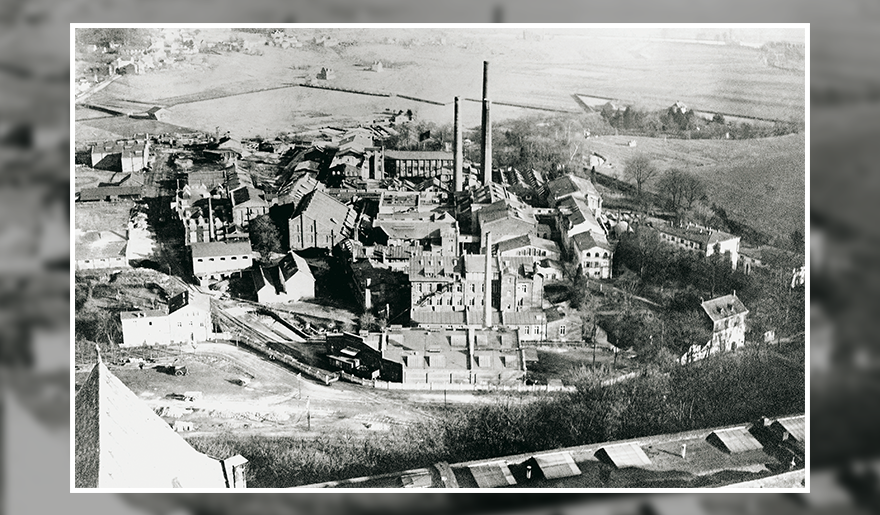
Since the location of the factory within Cologne’s walls stifled growth opportunities, Rolffs was soon looking for a new production site in the region. He needed a large plot of land with potential for future expansion, good transport connections to Cologne and with an ample supply of clean, low-lime and iron-free water to wash the calico with. On the eastern slopes of the Michaelsberg outside Siegburg, he found what he wanted – the so-called Siegfeld with its mill stream dating from the Middle Ages. There, the entrepreneur from Cologne built a new calico factory, launched in 1844. Step by step, he expanded his plot, which is still the seat of the mother plant and headquarters of the Siegwerk Group.

Modernisation as the recipe for success

Christian Gottlieb Rolffs was a dynamic factory owner and always looking for new ways of improving production. The angles for this were ink manufacturing and printing technology. For instance, in 1848 he added red printing using madder, a plant originating from the Mediterranean, to his portfolio. Then he improved the processing of indigo with a new rubbing machine and speeded up production with a new relief printing machine for multicolour printing.

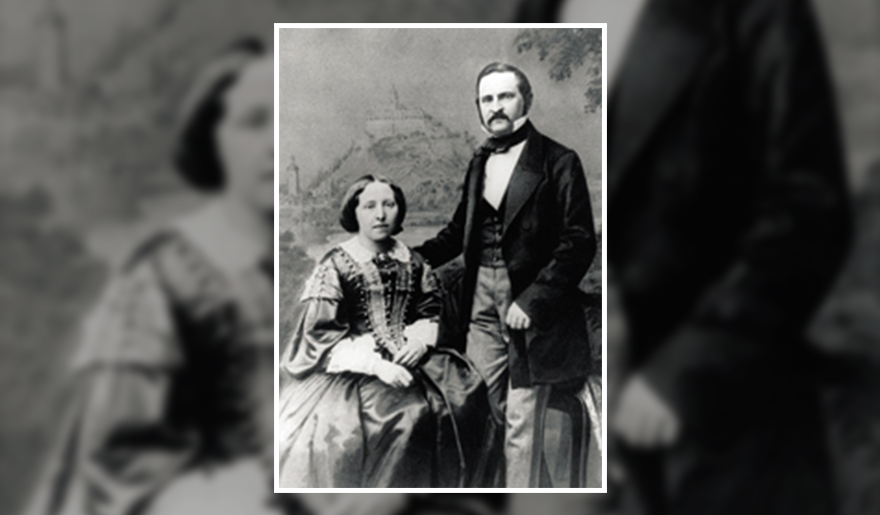
Berta and Georg-Ludwig Keller – Christian Gottlieb Rolffs´ son-in-law Georg-Ludwig Keller boosted modernisation of the factory with roller printing facilities.

In July 1851, Christian Gottlieb Rolffs transferred the Kattunfabrik to his son Ernst Rolffs, along with his sons-in-law Georg-Ludwig Keller and Albano Korte. The three young men continued modernisation of the factory, which had already started under Christian Gottlieb Rolffs. Manual work was successively replaced by machine-based processes and these were continuously improved. From 1855 to 1858 modern roller printing equipment replaced the old relief printing machines. Productivity and the quality of colour prints experienced a boost. Time-consuming switches between dyeing and washing processes were made redundant – the new rollers pressed the ink into the fabric so precisely that a length of textile could pass through several rollers, each with its own colour, emerging from the machine with the printing completed in one run.

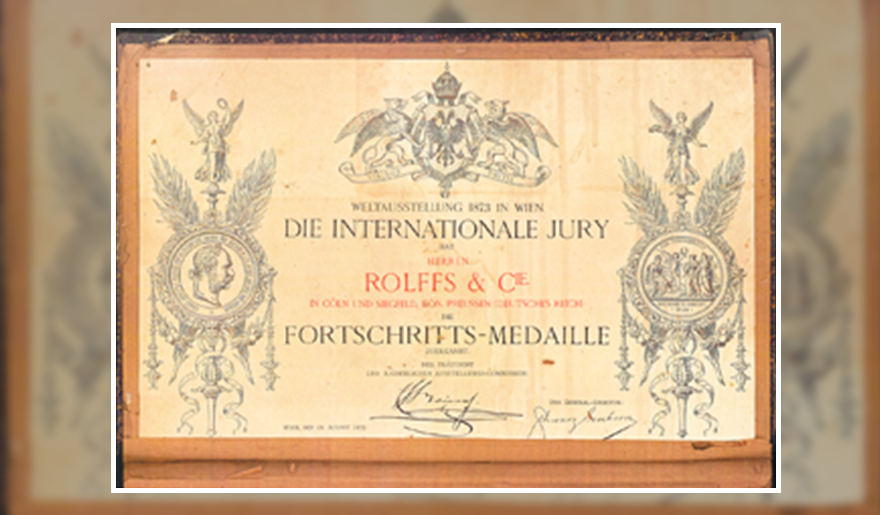
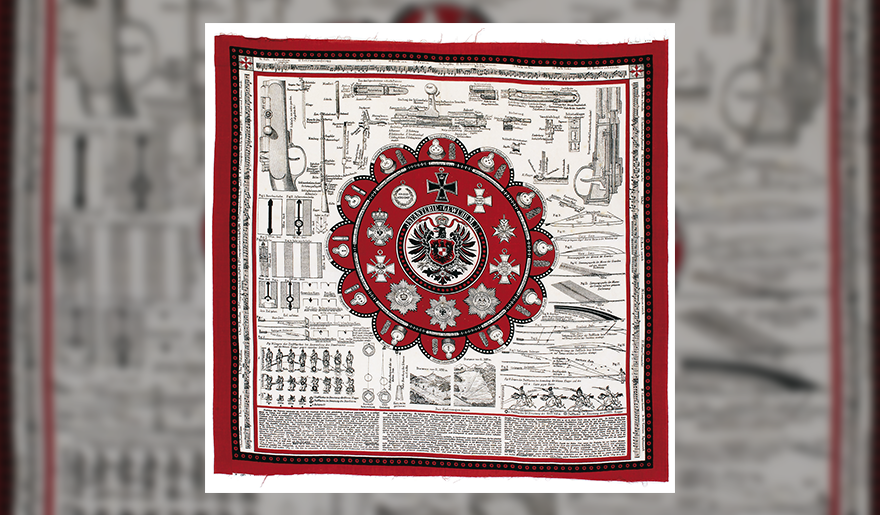
The Kattunfabrik quickly developed into one of the biggest cotton printing business in Germany. Besides producing for the domestic market, it exported textiles to the Netherlands, Denmark, Belgium, France, Italy and Romania. Trade relations extended to Turkey and the British colonies. Handkerchiefs with fashionable patterns were especially popular. Emperor Wilhelm’s portrait decorated textiles from Siegburg, along with those of other European monarchs and the popes in Rome. In Germany, Rolffs & Cie. was the only company with a license to produce handkerchiefs with printed instructions for army recruits, familiarising them with the use of military weapons. Such imaginative products , modern facilities and original inks made Kattunfabrik one of the most innovative companies in the industry. At the Vienna Expo in 1873, an international jury awarded a general “progress medal” to the firm.

The third generation, which joined the management of the company in 1878, was not content to rest on these laurels. Alfred and Eugen Keller as well as Fritz Korte continued to work on the firm’s expansion. Among the period’s most successful projects was the construction of a calico factory in Bohemian Friedland (then part of the Austro-Hungarian empire) where production started in 1883. It was managed by the chemist Dr. Eugen Keller, who moved to Bohemia along with master craftsman in dyeing and printing, skilled workers and administration staff. The new factory first produced kerchiefs, later also making fabric for garments and table cloths. Demand was high, so that production soon expanded. By the end of the 19th century, the branch in Friedland was already employing some 650 people. Together, both factories formed one of the biggest cotton printing firms in Europe.

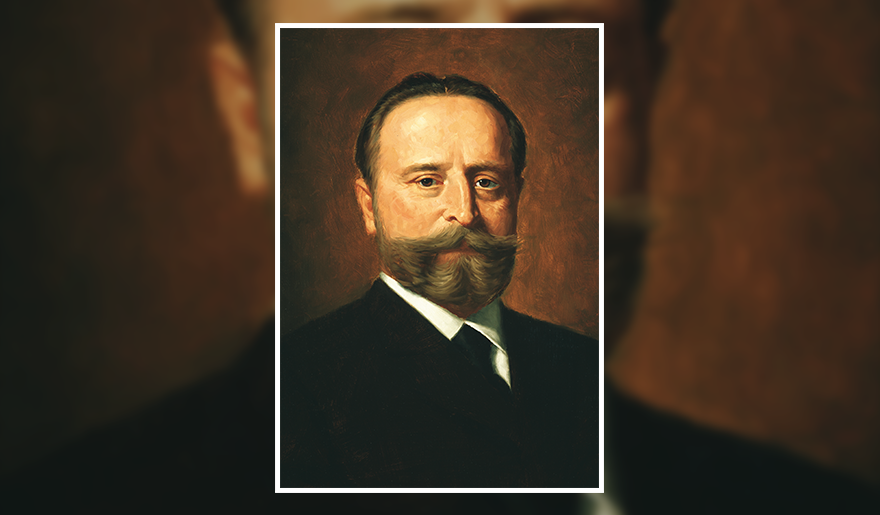
Christian Gottlieb Rolffs

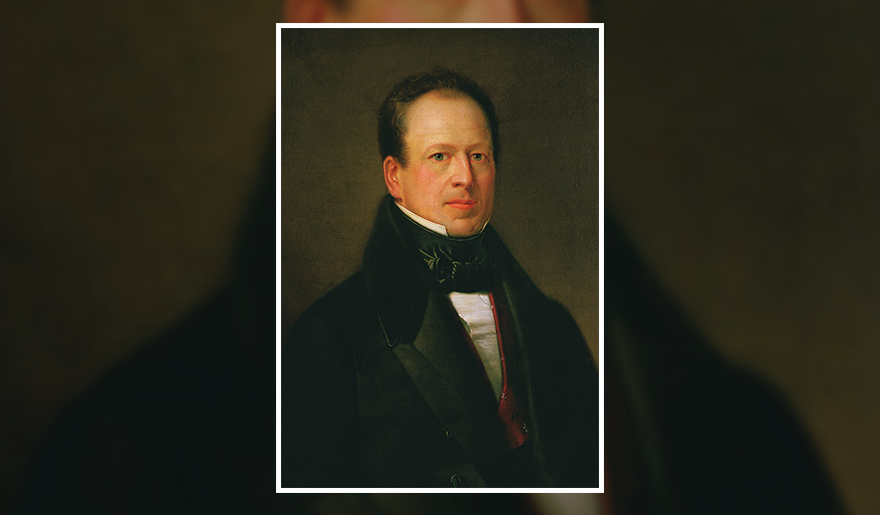
Christian Gottlieb Rolffs – Rolffs was originally a textile merchant, then built a calio factory (Kattunfabrik) in Cologne and put the foundation of Siegwerk in place by moving to Siegburg.
Christian Gottlieb Rolffs was “a far-sighted business man with a strong will, great working spirit and drive,” as a contemporary noted. Like many men of his generation, political struggles helped form him. Born in Bremervörde (North Germany) on January 21, 1795, he fought against Napoleon’s France as a volunteer in 1815. Following the war, he settled in Cologne and married Amalie Poensgen from Solingen, founding a trading company with his brother-in-law in 1824. Six years later, on August 1, 1830, he opened his “Manufakturwarenhandlung” (dealing in manufactured goods) in Cologne. During his business travels, he noticed a huge demand for coloured calico fabrics and established a calico printing and dyeing business in Cologne, which soon grew too big for the inner city. In nearby Siegburg, he found a larger site. On June 5, 1840, he bought his first plot near the mill stream and thus laid the foundation for Siegwerk. In the following years, further plots were acquired. After the death of his wife in 1846, Rolffs began to withdraw from active business. In 1847, his son Ernst and his sons-in-law Albano Korte and Georg-Ludwig Keller joined the company. Christian Gottlieb Rolffs finally retired in 1851. He died on August 22, 1871, in Bad Cannstatt.

From the “ink kitchen” to the Chemical Laboratory

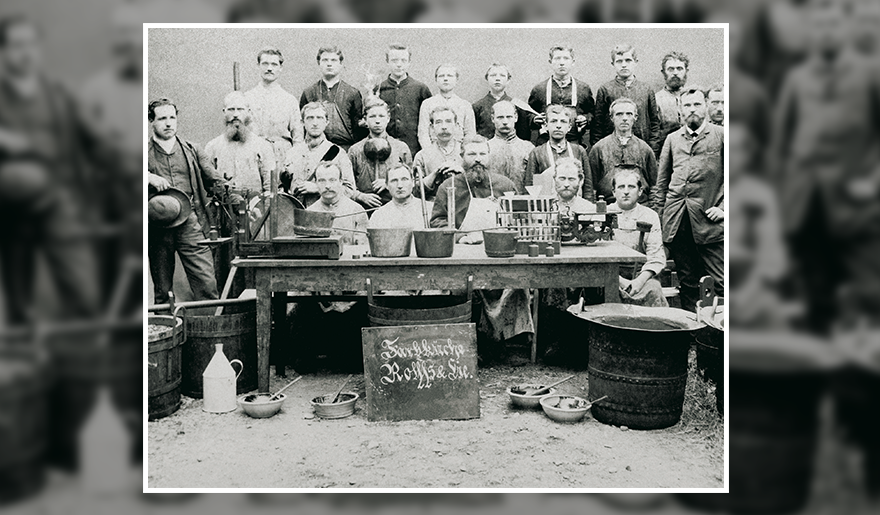
Colour specialists – The staff of Kattunfabrik's “ink kitchen” posing with some of their equipment in 1889.

The so-called “ink kitchen” was of fundamental importance to the success of the two factories, because ink/dye quality determined the success or failure of the imprinted fabrics. Not only did they need to be wash-resistant and lightproof, the colours needed to be bright and to meet the tastes of the era. In the Siegburg ink kitchen, master craftsmen worked on the correct blends and their application. The latter was problematic, since not all substances worked on all printing machines. For a long time, only natural dyes like indigo blue and madder red were available, involving elaborate extraction, blending and application processes. There was no standardised procedure of production, and work was solely based on craft skills. But with the emergence of artificial aniline and tar dyes towards the end of the 19th century, craftsmanship and experience no longer sufficed. To produce and utilise the new chemical dyes and inks, trained chemists and scientific laboratories became necessary. The ink kitchen in the Siegburg Kattunfabrik also used the new inks and dyes, and in the early 1890’s, the young chemist Dr. Fritz Rung was hired to ensure correct treatment of chemically produced colours and to produce the specialised printing inks made of aniline which were needed for copper rotary printing. Step by step, Rung transformed the ink kitchen into a chemical laboratory, which gave rise to the “Siegwerk Chemisches Laboratorium GmbH” in 1911.

The engraving plant as a field for experiments

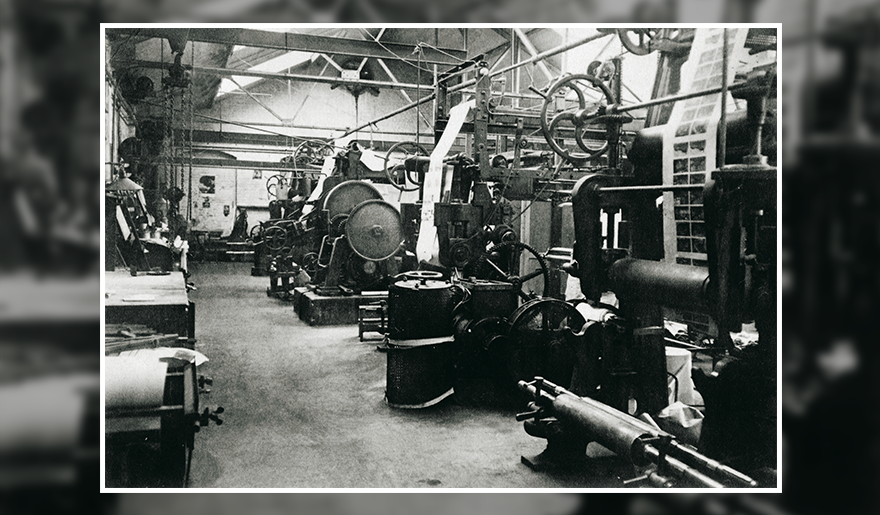
For work in the Kattunfabrik, the production of print rollers in the engraving plant was as important as the printing inks made in the ink kitchen. Here too, specialists were originally employed to hand-engrave patterns on the copper gravure rollers. And in the engraving plant, a further representative of the third generation of owners was active: Ernst Rolffs. The trained chemist, who had joined Kattunfabrik’s management as a partner in 1891, was very open to experiments and intensely concerned himself with the engraving process.

The engraving procedure common in those days was very intricate and required much manual skill. Quick implementation of increasingly frequent pattern and colour changes was impossible this way. Some designs required eight to ten rollers, production of which took five to six weeks. Rolffs sought ways of accelerating this process. In Kattunfabrik’s engraving plant, he experimented with various procedures and went to several research and training institutes to study the latest reproduction technology. In the late 1890’s, he had established a “gravure research department” at Kattunfabrik, which employed a reproduction technician from 1900 onwards.

Advertisement – With gravure, called copper printing here, Photogravur opened new roads in printing.

Impulses came from the aquatinta technology, which had been developed from the earlier mezzotinto procedure at the end of the 18th century. Another influence were the continuous-tone copper etching methods based on the implementation of grain screens at the beginning of the 19th century. Role models also included heliogravure, developed in England and Vienna from 1850 onwards, along with the technology for the so-called “Rembrandt Prints”, which emerged around 1890 using reproduction screens and facilitating genuine halftones via varying etching depth. Along with mezzotinto gravure, also developed around 1890, this technique was an important inspiration for Ernst Rolffs’ work – compared to the grain screens, whose contrast dynamics and detail printing were relatively modest in those days. Soon after his own patents were registered, Rolffs’ technology became known to the printing world as the “Siegburg procedures”.

In 1899, Rolffs submitted three inventions to the German patent authorities. The first was a “gravure roller with a cross screen protruding along the whole picture of the print roller”. The second was a procedure to produce this roller, “characterised by the fact that the slide to be copied onto the print roller in the accustomed way is dissected by transparent crossed lines.” The third was a “procedure to evenly coat rollers with light-sensitive or similar layers, consisting of applying the liquid substance of the layer as a screw line.”

With this new technology, Kattunfabrik could shorten engraving procedures to just a few days. It was thus feasible to depict current political affairs like China’s Boxer Rebellion in 1900/1901 – when Europe’s colonial powers sent a so-called “penal expedition” under German command following a massacre committed against Christians and the murder of the German envoy. Eight days after news of Peking being stormed by the Europeans had reached home, Rolffs & Cie. were able to market 50,000 kerchiefs illustrating the sensational event all over the world. Ernst Rolffs’ gravure procedure received great attention in the textile industry, and soon, other companies were buying licenses for the patented method.

From indigo to aniline
Textile dyes were mainly extracted from plants until well into the 19th century. For long, the most popular and widely used was indigo blue. In a complex procedure, it was extracted from the indigo plant (“anil” in Portuguese). In the mid-19th century, the growing chemical sector discovered that dyes could also be manufactured artificially. Just 18 years old in 1856, William Henry Perkin discovered an intense and lightfast violet colouring substance during experiments with coal tar – aniline purple, also known as “Mauvein”. Perkin immediately founded a factory to produce the new substance. In Germany, BASF (Badische Anilin- und Sodafabrik) was the first company to manufacture aniline dyes in 1865. Step by step, the range of artificial dyes was extended, since they were of higher quality and cheaper to produce than natural ones. In 1880, the chemist Adolph von Bayer accomplished the synthesis of indigo blue. BASF commenced production in industrial quantities in 1897 and offered the popular shade as an artificial substance at a reasonable price.

Paper instead of textile – The founding of the Deutsche Photogravur AG

Dr. August Nefgen – The chemist switched from the Kattunfabrik laboratory to the Deutsche Photogravur AG.

Successful application of his gravure method inspired Ernst Rolffs to devote himself to gravure research and development entirely. On April 1, 1902, he left the Kattunfabrik partnership. From now on, he ran the gravure department he had built up as an independent entity with the existing staff. In 1903, he employed a further chemist – Dr. August Nefgen who had formerly worked in Kattunfabrik’s chemical laboratory. This proved a lucky decision, since Nefgen not only supported Rolffs in the improvement of photo gravure, but also developed new printing processes on his own. Later, the chemist Dr. Karl Bleibtreu joined Rolffs’ developer team – he too came from Kattunfabrik’s chemical laboratory.

In 1903, Rolffs was still mainly working on textile printing, but he had already realised that his procedure was applicable in paper printing, too. In an address to the 5th International Chemistry Congress in Berlin he explained: “My procedure was developed for Kattundruck, but it has also aroused interest regarding paper printing – meaning illustration and wallpaper printing – and the largest engraving facility for wall paper printing has already adopted this method. Illustration printing will probably soon follow, because it is clear that the same pictures and effects currently produced via plates can be manufactured with rollers.”

That was a prophecy that was soon to be self-fulfilling. It was Ernst Rolffs himself who founded one of the first German illustration gravure printing houses. In a joint venture with Dr. Eduard Mertens, mentioned at the beginning of this chapter and the owner of said “largest engraving facility for wall paper printing”. What was not true, however, was that Mertens’ “Graphische Anstalt in Berlin”, founded in 1897, was using Rolffs’ procedure. Rather, Mertens had developed his own technique of producing gravure rollers photo-chemically, and had applied it successfully in wall-paper printing. For this reason, Mertens viewed the Siegburg method as an imitation and contested Rolffs’ patent. The ensuing battle over intellectual property rights to photo gravure lasted several years and only ended with the founding of the Deutsche Photogravur AG in 1906.

That company had a share capital worth 1.3 million German marks. Mertens’ and Rolffs’ stakes were covered by their patents, inventions and experience – with Mertens holding 666,000 and Rolffs 334,000 German marks. The purpose of the company was the production and distribution of graphical products and “artistic paper prints”. Ernst Rolffs became chairman of the supervisory board, with Dr. Eduard Mertens acting as his deputy. The board of management consisted of Rolffs’ chemist Dr. August Nefgen and Dr. Martin Schöpff, an aide to Mertens in Berlin. In the close vicinity of the Kattunfabrik, the company built a new seat, housing the printing and development departments.

Copper and blade – the development of gravure around 1900
Obviously, the development of gravure was in the air around the turn of the century. Inspired by photography, artists and engineers in various European countries were looking for a new machine-based printing technology. In Austria, Karel Klic invented heliogravure in 1890, presented astoundingly accurate reproductions of artworks and further developed his procedure into a graphical gravure process. At his suggestion in 1895, the “Rembrandt Intaglio Printing Co. Ltd.” was founded in British Lancaster. As the first modern gravure company it produced art publications in large editions via a rotary press procedure. Viennese Theodor Reich imitated the Klic method and developed gravure rotary machines with the engineer John Wood. In turn, the latter also built machines for the Bruckmann company in Munich, which in 1904 became Germany’s first gravure business to employ single-coloured rotary gravure, called mezzotinto gravure.
Contentmargin